
Blog Feed

Eating Fabulous Food Without Going Overboard

As I wandered around a bookstore waiting for a flight to Paris for work, I couldn’t believe my good fortune in discovering the biography of Julia Childs entitled, Dearie, by Bob Spitz. Julia Childs, one of the first celebrity chefs, has many fabulous and notable quotes.  I include a few of them in my new book, Eat.Q. I mention Julia in the chapter about how to successfully navigate pleasure eating.  For many of us, eating tasty, mouthwatering food is the hardest thing to do without ridiculously overeating (see chapter 5).   From reading her biography, I learned something fascinating.  Julia seemed to have a unique knack for eating mindfully.

If you read this book, beware!  About p. 119, you may just start to salivate.  All the talk about cheese soufflés, mushroom omelets, béchamel sauce, beef bourguignon (and so much more!) can make a person pretty hungry.


Here are 4 reflections on her biography from a kindred soul who also loves and appreciates eating exceptional food in a mindful way.

1)      Cooking Can Be a Learned Skill—Thankfully!  My clients often throw up their hands and say, “But I don’t know how to cook,” when we discuss the many ways in which cooking at home can help you to be a more mindful eater and manage your weight/health.  Julia was a good example of the fact that you don’t have to be born with a whisk in your hand to be a good cook.  She admits many times to being clueless in the kitchen prior to her marriage.  For her, it was practice, practice, practice.  She went to school to learn how to cook a long time before she ever taught anyone else.  When she was trying to perfect a recipe, she would try it out many, many times.  In fact, it took over a year and 284 pounds of flour to develop one bread recipe.

Julia Child’s Quote:  “I was 32 when I started cooking; up until then, I just ate.”

 2)      Food+Relationship Dynamic.  I was enthralled and captivated by the romantic connection between Julia, her husband and food.  Their love of food and her desire to connect with him around it was a passionate part of their relationship.  Who hasn’t been there?  We woo our partners with food.  Think for a minute about the roll food plays in your own relationships.  I discuss social eating and the sneaky impact of those around you on the way you eat in Eat.Q (chapter six).

Julie Child’s Quote: I think careful cooking is love, don’t you? The loveliest thing you can cook for someone who’s close to you is about as nice a valentine as you can give.

3)      The Turning Point Meal.   I paused at p. 172.  Although Julia doesn’t mention the words “mindful eating,” the description of her reaction to eating oysters in Paris for the first time was in lock step with the concept.  Initially, when she arrived in Paris, she stuck to two familiar meals.  Then, one night she ordered something new.  The book said, “it was like somebody had shown her what it really meant to eat, not simply to fill her stomach with food, but—to eat, to savor each glorious mouthful with gusto.”  It was a turning point meal that made her appreciate food in a new way.  Maybe you can think of your own “turning point meal.”  This would be a meal that made you savor the food, not just eat it.

Julia Child’s Quote:  “Everything in moderation…including moderation.”

4)      Just Eat Mindfully.  There is lots of talk of food but thankfully no mention of weight obsession until p. 461 (yes, this is a long book—557 pages!).   Around 1989, Julia indicated that the “food police” came out.  She stated that suddenly, “butter, cream, veal, sugar, marrow, potatoes and fat,” became, “the seven dirty words you can’t say on television.”  She wondered, “what happened to good old moderation.”  (p. 461).  This makes sense.  Mindful eaters have learned how to gauge their eating, even of good food, without obsessing over calories or even hopping on a scale.  It’s interesting to ponder why Julia began to notice a dramatic shift in the anxiety over the way we eat in the 1980’s.                                                                                          

Julia Child’s Quote:  As we say in the American Institute of Wine and Food, small helpings, no seconds. A little bit of everything. No snacking. And have a good time.

Julia Childs seemed to be another example of the age old saying, “Do what you love and the rest will follow.”  Her exact words were, “Find something you’re passionate about and keep tremendously interested in it.” 
So Simple, So Tasty, So Healthy: Sofrito

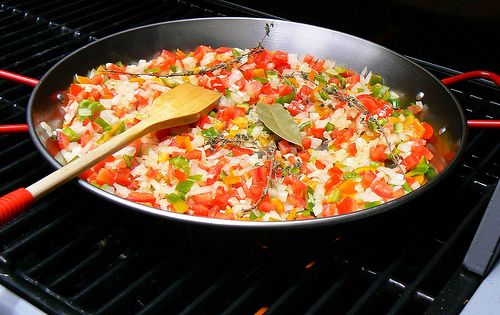
As readers of Zest for Life know, rare is the recipe of mine that doesn’t start with a chopped onion sautéed in olive oil with some minced garlic. Once the onion is translucent I’ll add tomatoes, thyme and bay leaf, cook it another 15 minutes and there you have it: Spanish sofrito.

If, instead of tomatoes, you add finely chopped carrots and celery, you get soffritto (spelled with two f’s and two t’s), Italy’s answer to sofrito. In France this mixture—often cooked in butter, rather than olive oil—is called mirepoix, and it forms the backbone of all stews, soups, stocks and sauces. As you can see, sof(f)rit(t)o is as Mediterranean as it gets!

I have been using sofrito as my culinary starting point for as long as I can remember, partly because my mother and grandmother did so, and partly because I know that this mixture, lightly salted and patiently stirred over medium heat until fragrant and al dente, imparts marvelous flavors to dishes in the way that stock cubes, salt and pepper just can’t.

I didn’t realize, however, that sof(f)rito also has proven medicinal benefits. That is, until I read about a new study into the health-giving properties of this humble but tasty concoction.

In a study (1) published in the journal Food Chemistry, researchers at the University of Barcelona and the CIBERobn network in Spain identified at least 40 different polyphenols and carotenoids—compounds with antioxidant and anti-inflammatory properties—in sofrito by using a high-resolution mass spectrometry technique.

They found that the combination of tomato, olive oil, garlic and onion in sofrito increases the amount of bioactive compounds that help lower the risk of cardiovascular disease and cancer. The bioactive compounds they found in sofrito included polyphenols, carotenoids and vitamin C. Various studies have shown that the intake of carotenoids such as lycopene lowers the risk of prostate cancer, and the consumption of foods rich in beta-carotene may help reduce the incidence of lung cancer.

Incidentally, the researchers recommended using virgin olive oil, rather than sunflower oil, to prepare sofrito; indeed, they found that recipes where olive oil made up 10% of the dish had particularly beneficial properties.

All this is music to my ears. Not only because it highlights that nutritional health does not require expensive supplements and rarefied “super-foods,” but can be found in simple but oh-so-flavorsome vegetable combinations rustled up in a simple skillet.

This study also echoes my favorite Mediterranean-diet mantra of “nutrient synergy,” i.e. that it is the combination of a wide range of seasonal vegetables that you can buy at any supermarket which supports our health. Nutrient synergies—where compounds in one food reinforce the beneficial effects of nutrients in another food—abound in multi-ingredient preparations such as sof(f)rito.

Three Reasons Why Eating Well Is Not Just About Food

The Mediterranean diet was voted the best diet in 2019 by US News and World Report and it includes many foods that can help your health—but when it comes to eating healthy, this diet shows that it is not just about the food.

People who follow this diet in Greece, Spain, and other Mediterranean countries might be healthy for other reasons. They tend to eat with others, pay attention to their food, and take their time to enjoy it. The social part of eating and how you think about food can be as important as the food itself!article continues after advertisement

There are some ways to planning meals and eating foods that can build your energy and health. Here are the three things that we should learn about from the Mediterranean Diet and how we think of food:

1. The Social Side of Eating

  • Eat together: Whether you have a large family, a roommate, or a pet, eat with someone and make your mealtime pleasant.
  • Eat with your children: Research shows that eating meals as a family several times a week helps children get better grades. Children who eat with their families regularly are less likely to consume alcohol or illegal drugs.
  • Be aware of family pressures and habits: Some families have strong traditions about food such as eating everything on your plate, overeating on special occasions, drinking a lot of alcohol or eating foods with a lot of fat, sugar, and salt. Your family members might say they want you to be healthy but try to get you to eat and drink what they normally do. Or they might say having obesity is OK because everyone in the family has it. Think about your own health, having less pain, and creating some new traditions for your family, including eating healthier foods and being more active. You can lead your family to a healthier and longer life.

2. Mind Your Eating Habits

  • Plan your meals: Try to shop once a week so you have enough food for the whole week. Avoid making quick trips to the store or a fast food restaurant when you are hungry. When you do this, you are likely to buy processed foods that are high in salt, fat, and sugar. Keep healthy food at home or in your car to avoid this.
  • Keep healthy foods at home: You might want to keep chicken in the freezer or brown rice in the pantry. Having nuts available for snacks gives you fats, protein, and vitamins. They are easy to pack on-the-go and can be consumed quickly.
  • Have a backup plan: If you plan to cook from scratch but have to stay late at work, what will you do? Decide where to shop for healthier take-out food, or keep a couple of healthy items in the freezer or pantry that you can make quickly. Many fast food restaurants now have healthy options. You can check the menu online and choose healthy foods based on calorie count and other nutritional information, such as the amount of sodium or fat.
  • Avoid planning complicated meals: It can be tempting to order takeout. Also, you might not cook for yourself often if it is a lot of work or you don’t enjoy it.
  • Listen to your body: Your body will tell you when it is full, just as it tells you when you are tired and need sleep. This is another reason to pay attention to what you eat. You might want to keep eating, but know you will be too full if you do. In a restaurant, you can ask to have half your meal put in a box to take home. At home, you can put the food away and get some later if you really want it. There are several simple ways to get better at listening to your body. Some people have found that stopping when they feel “80 percent full” is a good way to stay mindful. Others find taking a few breaths or saying a prayer before taking a bite increases mindfulness while eating. Pick a method you like, and try it for 30 days. After that, it will become a habit.
  • Try not to judge or think badly about yourself: Blaming yourself can make you feel helpless. It can also lead to eating high-calorie foods for comfort. If you have eaten inflammatory foods all your life, switching to anti-inflammatory foods will take some time.

article continues after advertisement

3. Take the Time to Enjoy Food

  • Don’t shop when you are hungry, tired or in a rush. 
  • Figure out your cooking style: Do you like using a Crock-Pot or instant pot? Cooking a lot of food in one day and storing it for later? Cook the way you enjoy doing it.
  • Enjoy your treats: A piece of chocolate, a pastry, a hot dog, or a beer can all be enjoyable treats. Your goal is to avoid having so much of these foods that your body gets inflamed and stays that way. Instead, try eating these foods in smaller amounts and on special occasions. Really enjoy them if you like them. Remember, how you think about your food matters to your health, too!
  • Don’t leave work hungry at the end of the day: Hunger might send you to the drive-through for a fast food snack instead of home to cook a healthy meal. Keep healthy “emergency snacks” in your bag or car, such as a piece of fruit, healthy popcorn, or a handful of unsalted nuts. Read the labels on energy bars carefully. They often contain a lot of sugar and are not healthy.
  • Practice mindful eating: Eating while you watch TV, read a magazine, text or surf the web is common, but it’s a bad habit for health. This is because you are not usually aware of what you are eating during those times. When you eat, try paying attention to what you taste, smell, touch, hear, and see. This is called “mindful eating,” and it is a good way to enjoy your food more, reduce stress, and even eat less.

Introduce Yourself (Example Post)

This is an example post, originally published as part of Blogging University. Enroll in one of our ten programs, and start your blog right.

You’re going to publish a post today. Don’t worry about how your blog looks. Don’t worry if you haven’t given it a name yet, or you’re feeling overwhelmed. Just click the “New Post” button, and tell us why you’re here.

Why do this?

  • Because it gives new readers context. What are you about? Why should they read your blog?
  • Because it will help you focus you own ideas about your blog and what you’d like to do with it.

The post can be short or long, a personal intro to your life or a bloggy mission statement, a manifesto for the future or a simple outline of your the types of things you hope to publish.

To help you get started, here are a few questions:

  • Why are you blogging publicly, rather than keeping a personal journal?
  • What topics do you think you’ll write about?
  • Who would you love to connect with via your blog?
  • If you blog successfully throughout the next year, what would you hope to have accomplished?

You’re not locked into any of this; one of the wonderful things about blogs is how they constantly evolve as we learn, grow, and interact with one another — but it’s good to know where and why you started, and articulating your goals may just give you a few other post ideas.

Can’t think how to get started? Just write the first thing that pops into your head. Anne Lamott, author of a book on writing we love, says that you need to give yourself permission to write a “crappy first draft”. Anne makes a great point — just start writing, and worry about editing it later.

When you’re ready to publish, give your post three to five tags that describe your blog’s focus — writing, photography, fiction, parenting, food, cars, movies, sports, whatever. These tags will help others who care about your topics find you in the Reader. Make sure one of the tags is “zerotohero,” so other new bloggers can find you, too.