
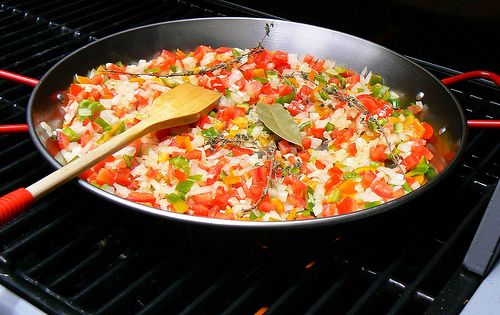
As readers of Zest for Life know, rare is the recipe of mine that doesn’t start with a chopped onion sautéed in olive oil with some minced garlic. Once the onion is translucent I’ll add tomatoes, thyme and bay leaf, cook it another 15 minutes and there you have it: Spanish sofrito.
If, instead of tomatoes, you add finely chopped carrots and celery, you get soffritto (spelled with two f’s and two t’s), Italy’s answer to sofrito. In France this mixture—often cooked in butter, rather than olive oil—is called mirepoix, and it forms the backbone of all stews, soups, stocks and sauces. As you can see, sof(f)rit(t)o is as Mediterranean as it gets!
I have been using sofrito as my culinary starting point for as long as I can remember, partly because my mother and grandmother did so, and partly because I know that this mixture, lightly salted and patiently stirred over medium heat until fragrant and al dente, imparts marvelous flavors to dishes in the way that stock cubes, salt and pepper just can’t.
I didn’t realize, however, that sof(f)rito also has proven medicinal benefits. That is, until I read about a new study into the health-giving properties of this humble but tasty concoction.
In a study (1) published in the journal Food Chemistry, researchers at the University of Barcelona and the CIBERobn network in Spain identified at least 40 different polyphenols and carotenoids—compounds with antioxidant and anti-inflammatory properties—in sofrito by using a high-resolution mass spectrometry technique.
They found that the combination of tomato, olive oil, garlic and onion in sofrito increases the amount of bioactive compounds that help lower the risk of cardiovascular disease and cancer. The bioactive compounds they found in sofrito included polyphenols, carotenoids and vitamin C. Various studies have shown that the intake of carotenoids such as lycopene lowers the risk of prostate cancer, and the consumption of foods rich in beta-carotene may help reduce the incidence of lung cancer.
Incidentally, the researchers recommended using virgin olive oil, rather than sunflower oil, to prepare sofrito; indeed, they found that recipes where olive oil made up 10% of the dish had particularly beneficial properties.
All this is music to my ears. Not only because it highlights that nutritional health does not require expensive supplements and rarefied “super-foods,” but can be found in simple but oh-so-flavorsome vegetable combinations rustled up in a simple skillet.
This study also echoes my favorite Mediterranean-diet mantra of “nutrient synergy,” i.e. that it is the combination of a wide range of seasonal vegetables that you can buy at any supermarket which supports our health. Nutrient synergies—where compounds in one food reinforce the beneficial effects of nutrients in another food—abound in multi-ingredient preparations such as sof(f)rito.
 tests.science.blog